TPAD01 Reliable Mock Test | TPAD01 Latest Test Cost
Wiki Article
In recent, Getcertkey began to provide you with the latest copyright dumps about IT certification test, such as Proofpoint TPAD01 Certification Dumps are developed based on the latest IT certification copyright. Getcertkey Proofpoint TPAD01 certification training dumps will tell you the latest news about the copyright. The changes of the copyright outline and those new questions that may appear are included in our dumps. So if you want to attend IT certification copyright, you'd better make the best of Getcertkey questions and answers. Only in this way can you prepare well for the copyright.
Proofpoint TPAD01 copyright copyright Topics:
| Topic | Details |
|---|---|
| Topic 1 |
|
| Topic 2 |
|
| Topic 3 |
|
| Topic 4 |
|
| Topic 5 |
|
| Topic 6 |
|
| Topic 7 |
|
| Topic 8 |
|
| Topic 9 |
|
| Topic 10 |
|
| Topic 11 |
|
| Topic 12 |
|
>> TPAD01 Reliable Mock Test <<
Proofpoint TPAD01 Latest Test Cost | TPAD01 Latest copyrightprep
To improve our products’ quality we employ first-tier experts and professional staff and to ensure that all the clients can pass the test we devote a lot of efforts to compile the TPAD01 learning guide. As long as you study with our TPAD01 copyright questions, we won’t let you suffer the loss of the money and energy and you will pass the TPAD01 copyright at the first try. After you pass the TPAD01 test you will enjoy the benefits the certificate brings to you such as you will be promoted by your boss in a short time and your wage will surpass your colleagues.
Proofpoint Threat Protection Administrator copyright Sample Questions (Q36-Q41):
NEW QUESTION # 36
Review the filter log exhibit.
What two actions have taken place in the filter logs for this message?
What the exhibit shows clearly:
- URL Defense processing is present in the log
- A spam-related action/flag is present
- A. The message has been flagged as SPAM.
- B. URL defense is blocking the message due to a malicious link.
- C. The email gets rejected due to excessive processing time.
- D. The connection times out and is dropped by the sender.
- E. The message was rejected due to its size.
Answer: A,B
Explanation:
The correct answers are A and C .
From the filter-log exhibit, two separate security actions are visible. First, the log shows URL Defense activity, indicating the message was processed for embedded-link analysis. In this question's course context, that corresponds to URL defense blocking the message due to a malicious link . Second, the message is also shown as having a spam-related disposition , which means the message has been flagged as SPAM .
Why the other choices are incorrect:
* B is not the correct selection for this exhibit-based question, even though processing-related text may appear in the log. The tested outcome here is the TAP URL-defense action plus the spam flag.
* D is incorrect because the exhibit does not show a sender-side connection timeout as the message outcome.
* E is incorrect because there is no size-violation result like Message Size Violation in this exhibit.
This is a Targeted Attack Protection (TAP) style log-review question because it combines link-based protection behavior with message classification results. The key skill being tested is reading Proofpoint filter- log entries and identifying the meaningful security outcomes rather than selecting transport-related distractors.
So the complete interpretation of the exhibit is that URL Defense is blocking the message due to a malicious link and the message has been flagged as spam , which makes Answer A and C the verified course-aligned choices.
NEW QUESTION # 37
Refer to the exhibit to see the interface used in this scenario.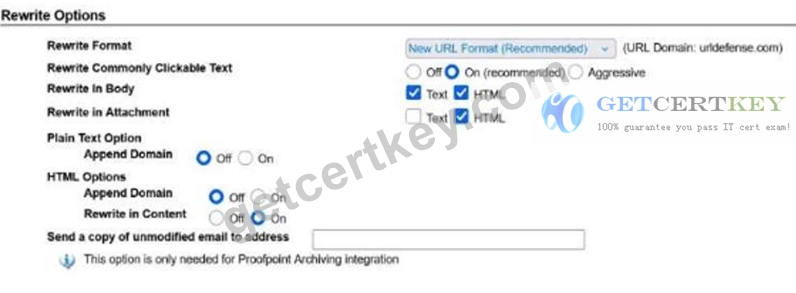
You can drag the divider between the question and the exhibit to the left to make the image larger.
Using those settings for URL Rewrite, which of the following will be rewritten?
Pick the 2 correct responses below.
- A. www.copyrightple.com
- B. https://www.copyrightple.com
- C. mail.copyrightple.com
- D. 10.1.1.1
- E. copyrightple.com
Answer: A,B
Explanation:
The correct answers are B. www.copyrightple.com and C. https://www.copyrightple.com .
From the exhibit, Rewrite Commonly Clickable Text is set to On (recommended) , and URL rewriting is enabled for both Text and HTML in the message body. That means Proofpoint will rewrite content that it recognizes as clickable URL-style text in normal message content. Both www.copyrightple.com and
https://www.copyrightple.com match that behavior because they are standard web-style URLs or commonly clickable web-address formats.
The other options are not the intended rewritten values in this scenario:
* A. copyrightple.com is plain domain text and is not the selected answer for this configuration.
* D. 10.1.1.1 is an IP address and is not one of the correct rewritten copyrightples in this question.
* E. mail.copyrightple.com is a hostname, but it is not one of the two expected rewritten values based on the course question.
This is a Targeted Attack Protection (TAP) question because URL Rewrite is part of Proofpoint's link- protection capability. The purpose of URL Rewrite is to transform recognized clickable URLs so they can be evaluated and protected through Proofpoint at click time. In this exhibit, the settings clearly support rewriting common clickable web text found in body content, which is why the correct two answers are www.copyrightple.
com and https://www.copyrightple.com .
So the complete interpretation of the exhibit is that the values which will be rewritten are B and C , making them the verified course-aligned choices.
NEW QUESTION # 38
What is the main function of Threat Response Auto-Pull (TRAP)?
- A. To automatically retract malicious emails from the inboxes of impacted users.
- B. To block every email that contains links, regardless of sender or content.
- C. To enable users to manage and delete their own suspected spam emails.
- D. To encrypt all emails sent internally to help prevent phishing attacks.
Answer: A
Explanation:
The correct answer is C. To automatically retract malicious emails from the inboxes of impacted users.
Proofpoint's product description for Threat Response Auto-Pull states that it automatically identifies and removes malicious emails from user inboxes after delivery when those messages are later determined to be unsafe. This is one of the defining functions of TRAP and is core to how Proofpoint reduces dwell time for email-based threats that initially evade blocking controls.
This is important because some attacks are not conclusively malicious at the exact moment of delivery. TAP and related analysis components can later determine that a delivered message is dangerous, and TRAP then enables remediation by pulling that message from affected mailboxes. The other options do not reflect the product's purpose. TRAP is not an end-user self-service spam-deletion tool, does not encrypt all internal email, and does not blanket-block all messages containing links. In the Threat Protection Administrator course, TAP and Threat Response topics emphasize post-delivery detection and remediation workflows, and TRAP is specifically the capability that automates message removal from inboxes once a threat is confirmed.
Therefore, the correct answer is C .
NEW QUESTION # 39
You log into the Protection Server and a rule you created yesterday is no longer enabled. Where can you find out what happened to the rule you created?
- A. Smart Search
- B. Alert Viewer
- C. Log Viewer
- D. Audit Logs
Answer: D
Explanation:
The correct answer is B. Audit Logs. Proofpoint's configuration auditing documentation states that the audit area records configuration changes and identifies details such as the time the action occurred and the console user who made the change. That is exactly the type of information needed when a rule that was previously enabled is no longer enabled and the administrator wants to know what happened.
This is different from Smart Search, which is used to investigate messages and message disposition, not administrative configuration history. Alert Viewer focuses on alert events, and Log Viewer is not the primary course answer for tracing who changed a rule's enabled state. The question is specifically about a rule's configuration state changing between yesterday and today, which is an administrative action trail problem. In the Threat Protection Administrator course, this is precisely what audit logging is for: establishing accountability and change history for rules, settings, and other administrative modifications.
In real-world operations, Audit Logs help answer questions like who disabled a rule, when it was changed, and whether the change was manual or part of another configuration update. Because the platform's configuration-auditing feature is designed for this use case, the verified and course-aligned answer is B. Audit Logs.
NEW QUESTION # 40
You can drag the divider between the question and exhibit to the left to make the image larger.
Refer to the exhibit.
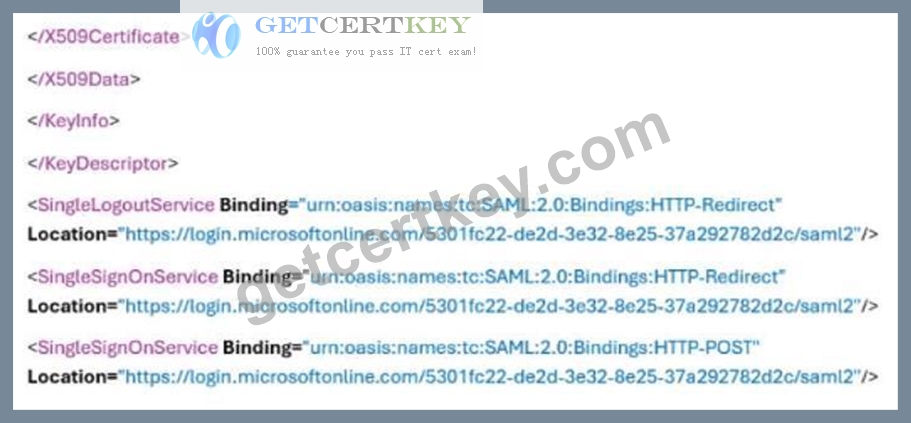
You are configuring SSO for Proofpoint Cloud Services, such as Cloud Admin, TAP Dashboard, Cloud Threat Response, CASB, and Identity Threat Response. The Microsoft O365 administrator sends you a portion of the XML file containing the SAML configuration. Which of the following strings should be entered in the "SAML Login Endpoint (required)" field in the Proofpoint Identity Provider Configuration?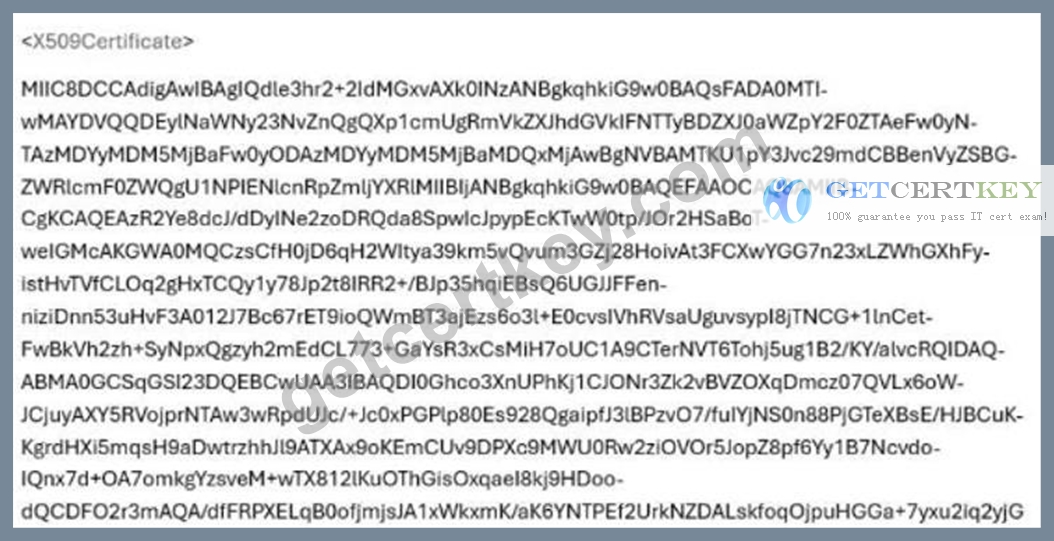
- A. The data between < X509Certificate > and < /X509Certificate >
- B. https://enduserauth.proofpoint.com/v1/token/samlauthorization
- C. SingleSignOnService Binding="urn:oasis:names:tc:SAML:2.0:Binding:HTTP-Redirect"
- D. https://login.microsoftonline.com/5301fc22-de2d-3e32-8e25-37a292782d2c/saml2
Answer: D
Explanation:
The correct answer is C. https://login.microsoftonline.com/5301fc22-de2d-3e32-8e25-37a292782d2c/saml2
.
The question is asking specifically for the value that should be entered in the "SAML Login Endpoint (required)" field in Proofpoint's Identity Provider configuration. In SAML metadata, that value is the Location attribute of the SingleSignOnService entry. In the exhibit, the XML clearly shows the Microsoft login URL as:
https://login.microsoftonline.com/5301fc22-de2d-3e32-8e25-37a292782d2c/saml2 That is the actual SAML login endpoint Proofpoint needs in order to redirect authentication requests to the Microsoft identity provider.
Why the other options are incorrect:
* A is the certificate content, which is used for trust and signature validation, not for the login endpoint.
* B is the XML element label and binding description, not the actual URL value that belongs in the field.
* D is a Proofpoint URL and not the Microsoft IdP SAML login endpoint shown in the metadata.
This is a User Management and federated-authentication question because it focuses on SSO configuration between Proofpoint Cloud Services and Microsoft O365 / Azure AD. The main concept being tested is knowing how to read SAML metadata correctly and extract the exact SingleSignOnService Location value.
So the complete interpretation of the exhibit is that the string to enter in the "SAML Login Endpoint (required)" field is the Microsoft SAML login URL shown in the XML, which makes Answer C the verified course-aligned choice.
NEW QUESTION # 41
......
Studying from an updated practice material is necessary to get success in the Proofpoint TPAD01 certification test on the first try. If you don't adopt this strategy, you will not be able to clear the Threat Protection Administrator copyright (TPAD01) copyrightination. Failure in the Threat Protection Administrator copyright (TPAD01) test will lead to loss of confidence, time, and money. Don't worry because "Getcertkey" is here to save you from these losses with its updated and real Proofpoint TPAD01 copyright questions.
TPAD01 Latest Test Cost: https://www.getcertkey.com/TPAD01_braindumps.html
- Quiz TPAD01 - Useful Threat Protection Administrator copyright Reliable Mock Test ???? Open ▛ www.pass4test.com ▟ enter ▷ TPAD01 ◁ and obtain a free download ????TPAD01 Reliable Test Question
- TPAD01 Valid Test Online ???? TPAD01 Trustworthy Source ???? Updated TPAD01 Dumps ???? Open website [ www.pdfvce.com ] and search for ➽ TPAD01 ???? for free download ????TPAD01 Pdf Free
- TPAD01 Reliable Test Question ???? Valid copyright TPAD01 Sheet ???? TPAD01 Pdf Free ???? Easily obtain free download of ⮆ TPAD01 ⮄ by searching on ⏩ www.prepawayete.com ⏪ ????TPAD01 New Cram Materials
- 100% Pass Unparalleled Proofpoint - TPAD01 - Threat Protection Administrator copyright Reliable Mock Test ???? Copy URL ➤ www.pdfvce.com ⮘ open and search for ▷ TPAD01 ◁ to download for free ????Latest TPAD01 copyright Answers
- 100% Pass Unparalleled Proofpoint - TPAD01 - Threat Protection Administrator copyright Reliable Mock Test ???? Easily obtain ➽ TPAD01 ???? for free download through ⇛ www.dumpsquestion.com ⇚ ????TPAD01 copyright Passing Score
- 100% Pass Unparalleled Proofpoint - TPAD01 - Threat Protection Administrator copyright Reliable Mock Test ???? Search for 「 TPAD01 」 and download it for free on ▶ www.pdfvce.com ◀ website ????Vce TPAD01 Test Simulator
- Simulated TPAD01 Test ???? TPAD01 Test Centres ???? TPAD01 Latest Study Materials ???? Open ➠ www.copyrightcollectionpass.com ???? enter ▛ TPAD01 ▟ and obtain a free download ????Reliable TPAD01 Dumps Files
- TPAD01 copyright Passing Score ???? Valid TPAD01 Test Topics ???? Simulated TPAD01 Test ???? ☀ www.pdfvce.com ️☀️ is best website to obtain ➡ TPAD01 ️⬅️ for free download ❇TPAD01 Reliable Test Voucher
- 100% Pass Unparalleled Proofpoint - TPAD01 - Threat Protection Administrator copyright Reliable Mock Test ???? Search on ☀ www.testkingpass.com ️☀️ for ➠ TPAD01 ???? to obtain copyright materials for free download ????Updated TPAD01 Dumps
- TPAD01 copyright Files for Busy Professionals ???? Search for ☀ TPAD01 ️☀️ and download it for free on 《 www.pdfvce.com 》 website ⚔Complete TPAD01 copyright Dumps
- TPAD01 Valid Test Online ???? TPAD01 Pdf Free ???? Simulated TPAD01 Test ???? Immediately open { www.copyright4labs.com } and search for { TPAD01 } to obtain a free download ????Updated TPAD01 Dumps
- aishaywhl850159.blogcudinti.com, bbsocialclub.com, honeyszqz474784.webdesign96.com, bookmarkgenius.com, marleypgqe906387.theisblog.com, thesocialvibes.com, maroonbookmarks.com, ghrcn.com, atozbookmark.com, pr1bookmarks.com, Disposable vapes